


- [Coios\' View ⑩] Saudi Arabia’s Vision 2030 and the Climate Contradiction: Hope Lies in the Next Generation
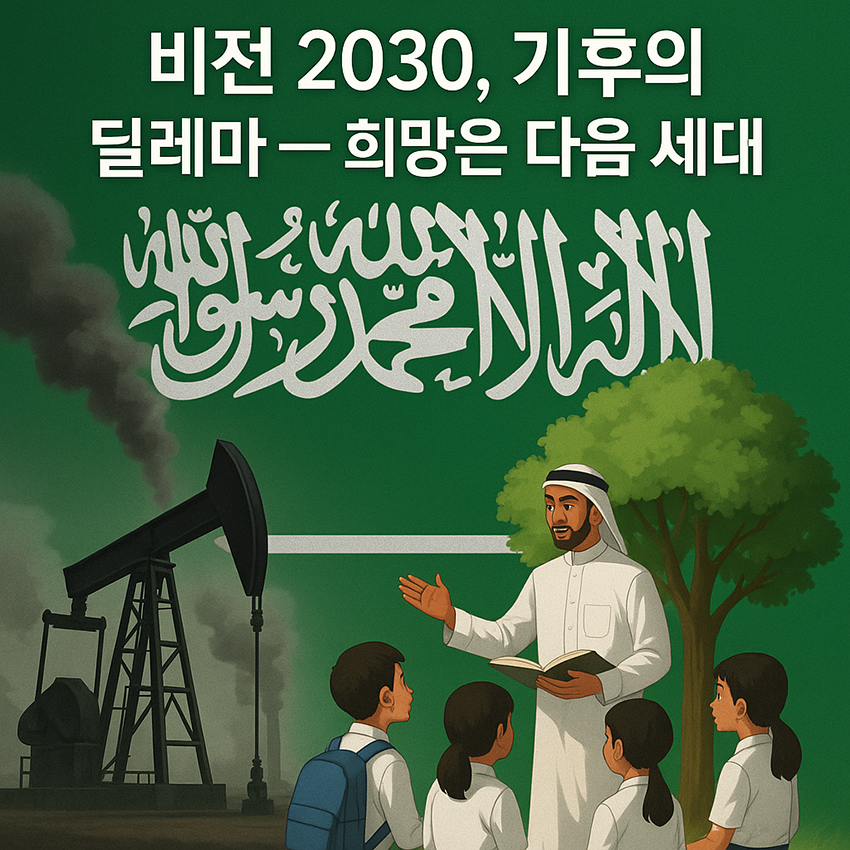
2016년, 사우디 정부는 국가의 원유 의존을 제거하고, 그로 인한 자원 한계 및 환경 피해를 극복하고자 하는 야심찬 프로젝트인 '비전 2030'을 발표했다. 이 계획은 국가의 수입원을 다각화하고, 사우디의 경제 및 문화적 강점을 강화하는 데 목적이 있다. 사우디아라비아는 그 이후 국내 기업을 육성하고, 유망한 학생들에게 기회를 제공하며, 청년들에게 문화를 홍보하는 데 많은 노력을 기울여 왔다.
그러나 과연 사우디가 환경적 목표를 달성하기 위한 실질적인 조치를 취했는지 의문을 제기할 수밖에 없다. 현재 시점에서 이 이니셔티브의 정점이라 할 2030년까지 5년밖에 남지 않았으며, 현실적으로 달성을 위해서는 변화가 이미 시작되어야 한다. 과연 변화는 있었을까?
안타깝게도, 경제적 다각화는 어느 정도 진행되었지만, 사우디아라비아는 온실가스 배출량을 실질적으로 줄이는 데 거의 진전이 없으며, 여전히 세계 최대 원유 수출국으로 남아 있다. (Climate Action Tracker, 2023) 사실, 사우디의 기후는 정부 정책의 희생양이라 해도 과언이 아니다. 원래도 사막 지역이라 기온이 높았지만, 온실가스 배출은 이 기온을 더욱 상승시킬 위험이 있다.
현재 여름철 기온은 섭씨 50도를 초과하는 일이 흔하며, 지구온난화는 금세기 말까지 기온을 최대 5.6도 더 상승시킬 수 있다. 이는 사우디의 또 다른 심각한 문제인 물 부족을 더욱 악화시킨다. 원래도 세계에서 가장 물이 부족한 국가 중 하나였지만, 강수량 감소와 증발량 증가—이 모두가 앞서 언급한 기온 상승의 결과—로 인해, 농업에 쓰이는 수자원이 15~20% 감소할 수 있으며, 이는 국토의 최대 25%를 사막화 위험에 빠뜨릴 수 있다 (Atlantic Council, 2025). 이 모든 상황은 사우디의 미래 기후와 다음 세대의 삶에 대해 암울한 그림을 그리고 있다.
만약 이런 환경 문제가 사우디 내부에만 국한된다면 다행일 수 있겠지만, 사우디는 최근 국제 기후 행동을 저해하는 움직임까지 보였다. 불과 5개월 전 열린 COP29 회의에서, 사우디는 화석연료 감축 논의에 강력히 반대하고, COP28에서 합의된 내용을 훼손하는 태도를 보였다 (Climate Action Tracker, 2023). 이는 더 깨끗한 사회를 지향한다고 주장하는 국가의 행보로서는 매우 우려스러운 일이다.
그럼에도 불구하고, 변화와 성장의 가능성은 여전히 존재한다. 사우디는 여전히 대규모 원유를 수출하고 온실가스를 배출하고 있지만, 최소한 이러한 행동의 위험성과 그 결과에 대처하는 방법을 다음 세대에게 교육하는 조치는 취하고 있다. 기후변화에 대한 교육은 과학, 사회 과목 등 여러 교육 과정에 통합되었고, NGO들은 워크숍, 세미나 같은 교육적 활동뿐 아니라, 나무 심기나 해변 정화 캠페인과 같은 실천적 활동을 통해 환경 의식을 고취시키고 있다.
하지만 이 교육 활동은 아직 시작된 지 얼마 되지 않아, 관련 전문 인력이 부족하며, 국민 대부분이 기후 위기의 심각성을 잘 인식하지 못하고, 환경 책임 의식이 낮은 편이다 (IPCGE, 2025). 그럼에도 불구하고, 이러한 인식 개선 노력은 더 밝고 친환경적인 미래로 나아가는 발판이 될 수 있다.
종합적으로 보면, 사우디아라비아는 지금까지 기후에 미치는 부정적 영향을 줄이기 위한 실질적인 조치를 거의 취하지 않았다. 그러나 정부가 현재를 더 푸르게 만들지는 못했지만, 우리는 기후에 대해 철저히 교육받은 다음 세대에게 희망을 걸 수 있다. 우리 모두를 위해, 그들이 현재 세대보다 더 나은 선택을 하기를 바란다.
* 본 기사는 ESG코리아뉴스 사우디아라비아 학생기자 이브라힘 부카리(Ibrahim Bukhari)의 영문 오피니언으로 원문의 내용은 아래와 같습니다.
"Saudi Arabia’s Vision 2030 and Climate Contradictions: Hope Lies in the Next Generation“
by Ibrahim Bukhari (SAUDI ARABIA)
In the year 2016, the Saudi government unveiled the initiative that would come to be known as Vision 2030, an ambitious project with the goal of eliminating the country’s reliance on crude oils due to their limited supply and environmental damage by diversifying the nation’s sources of income and emphasize the country’s economic and cultural strengths. While it is no question that the kingdom has done a lot to bolster its thriving plethora of national businesses, give opportunities to its promising students, and promote its culture to the youth, one has to ask whether or not the country has taken any action to reach its supposed environmental goals. At the time of writing, the country is five years away from reaching what is meant to be the zenith of this initiative, so for it to be realistically achieved, some form of change should have taken place by now. So have they?
Unfortunately, despite the kingdom branching out economically, it is has yet to make any meaningful reduction its greenhouse gas emissions, and is still considered the leading crude oil exporter globally, a far cry from it’s supposed goal of environmental care (Climate Action Tracker, 2023). As a matter of fact, Saudi Arabia’s climate is a suffering victim of its government’s actions. It being a desert, temperature were always high, but the country’s greenhouse gas emissions threaten to raise the heat even further. As it stands, the summer can surpass 50 degrees Celsius regularly, already giving it one of the highest average temperatures, but global warming could raise that by 5.6 degrees by the end of the century. This issue only further exacerbates another national concern, that being the country’s water scarcity. The kingdom was already one of the most water-scarce countries in the world, but lowering precipitation rates and rising evaporation rates, both of which are a result of the previously established rising temperatures, the country’s overall water reserves for agriculture may drop by 15-20 percent, putting up to 25 percent of the country’s land at risk of desertification (Atlantic Council, 2025). This all together paints a disturbing picture for the future of the country’s climate, and the lives of its future generations.
It would be a contained issue if the country’s environmental issues were limited to itself. However, Saudi Arabia has attempted to worsen global climate action during the COP29 conference, which took place only 5 months ago. During the international conference, Saudi Arabia took a hard stance against discussion of the mitigation of fossil fuels, and undermining the agreement to do so that took place at COP28 (Climate Action Tracker, 2023). This is a concerning display from a nation that claims to aim towards a cleaner society.
However, despite all of these actions, the potential for growth and change does still exist. While the country does continue to export crude oils and emit large amounts of greenhouse gases, it is taking steps to at the very least educate the next generation on the dangers of these actions, and methods of dealing with their consequences in response to their effects on the climate. Education on climate change has been integrated within multiple subjects of the country’s curriculum, such as science and social studies, while NGOs build further environmental awareness through both educational means, such as workshops and seminars, to more active ones, such as tree planting campaigns and beach cleanups. Unfortunately, the benefit of these acts are limited by the lack of professionals trained to teach these subjects, as these attempts to spread environmental awareness are a relatively recent venture. This is further compounded by just how new this is, as the people of the country are not very aware of the harm their climate has gone through, and thus have very limited senses of environmental responsibility (IPCGE, 2025). Despite these hurdles, these actions taken to make the public more aware have the potential to pave the way for a brighter and greener future.
Saudi Arabia has overall taken little action to lessen its negative effects on its climate despite the clock ticking closer and closer towards the year 2030. But, while the government has yet to make our present greener, we may hold hope in the next generation, who are being rigorously educate on how to keep our climate green and healthy. And so we put our faith on the next wave of the populace, and hope they can do better than their predecessors, for their sake, and ours.
Bibliography:
Climate Action Tracker (2023). Saudi Arabia.
https://climateactiontracker.org/countries/saudi-arabia/#:~:text=Saudi%20Arabia%20is%20already%20experiencing,4%C2%B0C%20this%20century
Atlantic Council (2025). Climate Profile: Saudi Arabia.
https://www.atlanticcouncil.org/programs/middle-east-programs/rafik-hariri-center-for-the-middle-east/empowerme/macromena/climate-profile-saudi-arabia/
IPCGE (2025). Environmental Education In Saudi Arabia: 6 Key Points.
https://www.ipgce.com/environmental-education-in-saudi-arabia-6-key-points/


BEST 뉴스
-
![[윤재은 칼럼] 집은 늘어나는데, 왜 내 집은 더 멀어지는가?](/data/news/202609/news_1789823761.1.jpg)
[윤재은 칼럼] 집은 늘어나는데, 왜 내 집은 더 멀어지는가?
정부와 서울시가 주택공급에 속도를 내고 있다. 이재명 대통령은 지난 9월 18일 기자회견에서 택지 개발과 재건축·재개발, 도시정비 등을 통해 주택공급을 최대한 신속하게 늘리겠다고 밝혔다. 총리실이 관련 상황을 매일 점검하고 대통령도 매주 보고받으며 구체적인 사업 진행 상황을 확인하고 있다고 설명했다. 주택... -
![[서정태의 ESG현장클리닉④] 중소기업의 공급망 ESG 평가대응, ESG 대응 체계 구축이 중요하다.](/data/news/202610/news_1791415383.1.png)
[서정태의 ESG현장클리닉④] 중소기업의 공급망 ESG 평가대응, ESG 대응 체계 구축이 중요하다.
▲서정태의 ESG현장클리닉, 중소기업의 공급망 ESG 평가대응, ESG 대응 체계 구축이 중요하다 [사진=Ai] 최근 ESG는 대기업이나 상장기업만의 과제가 아니다. 해외 바이어와 대기업이 공급망 전체의 환경·인권·안전·윤리·탄소배출 관리 수준을 확인하면서 중소기업에도 ESG 대응이 실... -
![[서정태의 ESG 현장클리닉③] 녹색인증과 녹색제품 인증, 정확히 구분해야 공공 조달 판로가 열린다.](/data/news/202609/news_1790464991.1.jpg)
[서정태의 ESG 현장클리닉③] 녹색인증과 녹색제품 인증, 정확히 구분해야 공공 조달 판로가 열린다.
▲서정태의 ESG현장클리닉, 기사의 이해를 돕기 위한 이미지 [사진=서정태, Ai] 탄소중립과 녹색성장이 국가 산업정책의 핵심으로 자리 잡으면서 공공 조달 시장에서도 에너지 절감, 온실가스 감축, 자원순환 및 환경오염 저감 성능을 갖춘 제품의 중요성이 높아지고 있다. 기... -
![[남재철의 기후&식량안보⑯] 농지가 사라지면 식량안보도 무너진다](/data/news/202609/news_1789427408.1.png)
[남재철의 기후&식량안보⑯] 농지가 사라지면 식량안보도 무너진다
▲ 남재철의 기후&식량안보, 농지가 사라지면 식량안보도 무너진다 [사진=Ai, 남재철] 식량안보가 국가안보의 핵심 의제로 부상하면서 농지는 더 이상 단순한 토지나 생산수단이 아니라 국가의 생존을 위한 전략자산으로 인식... -
![[남재철의 기후&식량안보⑲] 찬 이슬이 알려주는 농업의 시간, 한로(寒露)와 기후변화](/data/news/202610/news_1791175629.1.png)
[남재철의 기후&식량안보⑲] 찬 이슬이 알려주는 농업의 시간, 한로(寒露)와 기후변화
▲ 남재철의 기후&식량안보, 찬 이슬이 알려주는 농업의 시간, 한로(寒露)와 기후변화 [사진=남재철, Ai] 24절기 가운데 열일곱 번째인 한로(寒露)가 다가왔다. ... -
![[남재철의 기후&식량안보⑱] 추미애 도정 100일, 경기도의 미래전략은 어디에 있는가?](/data/news/202609/news_1790463608.1.png)
[남재철의 기후&식량안보⑱] 추미애 도정 100일, 경기도의 미래전략은 어디에 있는가?
▲ 추미애 도정 100일, 경기도의 미래전략은 어디에 있는가? [사진=남재철, Ai] 인수위의 정책 구상이 도정의 실행전략으로 이어져야 지난 6월, 추미애 경기도지사직 인수위원회(경기준비위원회)의 ‘에너지 순환경제 특별위원회’ 위원으로 ...

전체댓글 0

NEWS TOP 5
-
![[용석광의 컴플라이언스와 ESG] ㉘ CP 등급평가 절차와 제도 개편: 혜택을 쟁취하는 4단계 실무 로드맵](/data/news/202609/news_1789518962.1.png) 1
1[용석광의 컴플라이언스와 ESG] ㉘ CP 등급평가 절차와 제도 개편: 혜택을 쟁취하는 4단계 실무 로드맵
-
2
[용석광의 컴플라이언스와 ESG] ㉙ CP 등급평가 기준과 주요 지표: 100점 만점 속 고득점 전략
![[용석광의 컴플라이언스와 ESG] ㉙ CP 등급평가 기준과 주요 지표: 100점 만점 속 고득점 전략](/data/news/202609/news_1790768222.1.png)
-
3
[용석광의 컴플라이언스와 ESG] ㉚ CP 등급평가 실적보고서 작성 Tip: 평가위원의 눈을 사로잡는 합격 노하우
![[용석광의 컴플라이언스와 ESG] ㉚ CP 등급평가 실적보고서 작성 Tip: 평가위원의 눈을 사로잡는 합격 노하우](/data/news/202610/news_1790984693.1.png)
-
4
[용석광의 컴플라이언스와 ESG] ㉗ CP 도입을 위한 8대 핵심 요소: 형식적 껍데기를 깨부수는 진짜 뼈대
![[용석광의 컴플라이언스와 ESG] ㉗ CP 도입을 위한 8대 핵심 요소: 형식적 껍데기를 깨부수는 진짜 뼈대](/data/news/202609/news_1789355651.1.png)
-
5
[용석광의 컴플라이언스와 ESG] ㉛ CP 등급평가 현장·대면평가 대응: 심사위원의 질의를 압도하는 실증 전략
![[용석광의 컴플라이언스와 ESG] ㉛ CP 등급평가 현장·대면평가 대응: 심사위원의 질의를 압도하는 실증 전략](/data/news/202610/news_1791333927.1.png)
실시간뉴스
![[용석광의 컴플라이언스와 ESG] ㉜ CP 우수기업 인센티브 체계와 과징금 감경 규정: 준법경영이 가져다주는 강력한 재무적·행정적 혜택](/data/news/202610/news_1791586353.1.png)

추천뉴스

![[이슈 포커스] 조희대 대법원장 잇단 고발, 사법부의 독립과 책임을 묻다](/data/news/202610/news_1791926117.1.jpg)




사람들
more +-
![[세상을 바꾸는 사람들 ①] “내가 맡긴 돈은 어디로 갈까”…이상진 대표가 그리는 가치금융의 미래](/data/news/202610/news_1791608745.1.jpg)
[세상을 바꾸는 사람들 ①] “내가 맡긴 돈은 어디로 갈까”…이상진 대표가 그리는 가치금융의 미래
[편집자 주] 세상의 변화는 익숙한 현실에 질문을 던지고, 새로운 가능성을 찾아 나서는 사람들로... -

인류의 달 착륙 뒤에 있었던 여성 과학자…마거릿 해밀턴, 90세로 별세
1969년 7월 20일, 인류가 처음 달에 발을 내디딘 역사적인 순간에는 보이지 ... -

오바마 “책은 세상을 보는 방식을 바꾼다”…인생 바꾼 6권 다시 읽는다
버락 오바마 전 미국 대통령이 자신에게 깊은 영향을 준 책들을 다시 펼친다... -
UN 인권사무소, 말리 원주민 지도자 우무 디코 조명… “기후 정의와 원주민 권리 향상에 앞장”
유엔 인권사무소(UN Human Rights)가 7일 저녁 공식 X 계정을 통해 말리 출...
오피니언
more +-
![[남재철의 기후&식량안보⑳] 치유산업, 농촌의 미래를 바꾸는 새로운 성장동력](/data/news/202610/news_1791934095.1.png)
[남재철의 기후&식량안보⑳] 치유산업, 농촌의 미래를 바꾸는 새로운 성장동력
현대사회에서 건강과 행복은 더 이상 개인의 문제에 머물지 않는다. ... -
![[용석광의 컴플라이언스와 ESG] ㉝ CP 우수기업 인센티브 활용 전략: 혜택을 넘어 기업 가치 상승의 엔진으로](/data/news/202610/news_1791868278.1.png)
[용석광의 컴플라이언스와 ESG] ㉝ CP 우수기업 인센티브 활용 전략: 혜택을 넘어 기업 가치 상승의 엔진으로
공정거래 자율준수 프로그램(CP) 등급평가에서 AA 이상의 우수 등급을 획득한... -
![[강윤영의 사람을 살리는 콘텐츠] ② 불안의 시대, 나는 무엇을 선택할 것인가](/data/news/202610/news_1791762330.1.jpg)
[강윤영의 사람을 살리는 콘텐츠] ② 불안의 시대, 나는 무엇을 선택할 것인가
우리는 매일 수많은 정보를 만난다. 인공지능이 인간을 ... -
![[이경미의 AI와 미래공간 ①] AI가 바꾸는 공간, 인간의 삶](/data/news/202610/news_1791611453.1.jpg)
[이경미의 AI와 미래공간 ①] AI가 바꾸는 공간, 인간의 삶
사무실 책상에 앉아 인공지능(AI)과 함께 제안서를 작성하는 풍경은 이...
기획 / 탐방
more +-
![[ESG탐방] 농업 생산지가 관광 자원으로… 홋카이도 ‘패치워크 로드’와 ‘팜 토미타’가 보여준 농촌 경관의 가치](/data/news/202608/news_1788649267.1.jpeg)
[ESG탐방] 농업 생산지가 관광 자원으로… 홋카이도 ‘패치워크 로드’와 ‘팜 토미타’가 보여준 농촌 경관의 가치
일본 홋카이도 비에이의 ‘패치워크 로드’와 나카후라노의 ‘팜 토미... -
![[ESG탐방] 화산 지질이 만든 지하수의 흐름… 비에이 ‘시로가네 폭포’가 보여준 자연자산의 가치](/data/news/202608/news_1788185750.1.jpeg)
[ESG탐방] 화산 지질이 만든 지하수의 흐름… 비에이 ‘시로가네 폭포’가 보여준 자연자산의 가치
일본 홋카이도 비에이정의 시로가네 온천 지역에는 화산 지질과 지하수가 ... -
![[ESG탐방] 방재시설에서 관광자원으로... 자연과 함께 만들어진 홋카이도 비에이 ‘청의 호수’](/data/news/202608/news_1788183380.1.jpeg)
[ESG탐방] 방재시설에서 관광자원으로... 자연과 함께 만들어진 홋카이도 비에이 ‘청의 호수’
일본 홋카이도 비에이정에 위치한 청의 호수(아오이이케·青い池)는 처... -
![[ESG탐방] 아사히카와 디자인센터, 지역 산업을 지속가능한 자산으로 연결](/data/news/202608/news_1788189582.1.jpeg)
[ESG탐방] 아사히카와 디자인센터, 지역 산업을 지속가능한 자산으로 연결
일본 홋카이도 아사히카와시는 가구와 목공산업이 발달한 도시다. 홋카이도의 ...
포토뉴스
more +-

누구를 위한, 무엇을 위한 전쟁인가...가자지구에서 들려오는 마지막 외침
3일 (목요일) 가자지구는 또 다시 피로 물들었다. 이스라엘의 공습과 총격으로 단 이틀 만에 94명의 팔레스타인 민간인이 목숨을 잃었고, 이들 중 절반 가까운 45명은 단지 굶주림을 피하려 식량 배급소로 향하던 길에 있었을 뿐이라고 외신은 전했다. 병원 시체 안치실에서 자녀의 시... -
![[갤러리] 청년 환경예술가 오유나의 'Fragments of Self'](/data/news/202609/news_1790638962.1.jpg)
[갤러리] 청년 환경예술가 오유나의 'Fragments of Self'
〈Fragments of Self〉를 처음 구상했을 때 저는 무의식과 내면에 존재하는 여러 모습의 ‘나’를 보여주고 싶었습니다. 하나의 얼굴만으로는 경험과 기억, 감정에 따라 달라지는 저 자신을 설명하기 어렵다고 느꼈습니다. 그래서 여러 자화상과 신체, 방의 이미지를 겹쳐 하나의 인물을 만들기... -
![[갤러리] 청소년 환경예술가 이호석의 '대지의 호랑이'](/data/news/202608/news_1787014046.1.jpg)
[갤러리] 청소년 환경예술가 이호석의 '대지의 호랑이'
이 그림의 제목은 「대지의 호랑이」입니다. 저는 평소 호랑이를 좋아하고 강하고 멋있는 소재에 관심이 많아 호랑이를 작품의 주인공으로 선택했습니다. 이번 작품에서는 멸종위기종인 호랑이를 숲과 연결하여 자연과 환경에 대한 이야기를 담아보고 싶었습니다. 저는 호랑이가 건강하게... -
![[갤러리] 청소년 환경예술가 구시원의 '코끼리 가족의 약속'](/data/news/202607/news_1783294720.1.jpg)
[갤러리] 청소년 환경예술가 구시원의 '코끼리 가족의 약속'
저는 평소 코끼리를 가장 좋아해서 이 작품을 그리게 되었습니다. 코끼리는 초식동물 중에서도 몸집이 크고, 길고 힘있는 코와 멋진 상아를 가진 특별한 동물이라고 생각합니다. 그래서 다른 동물들보다 더욱 멋있고 매력적으로 느껴져 이번 작품의 주인공으로 선택했습니다. 그림을...